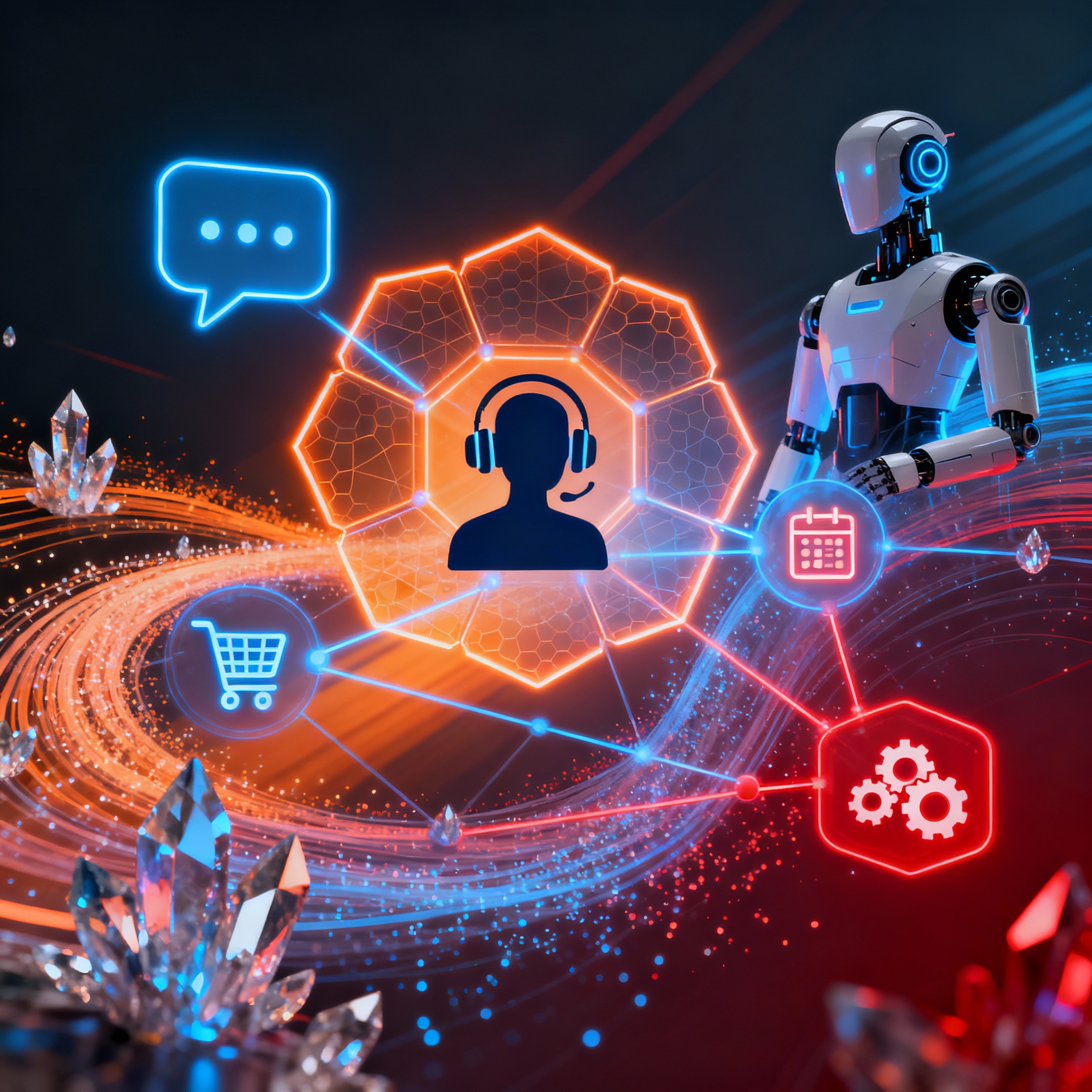
7 Most Common Chatbot Use Cases Driving Business Growth in 2025
7 Most Common Chatbot Use Cases Driving Business Growth in 2025
The chatbot landscape has undergone a dramatic transformation. What started as clunky, rule-based systems that frustrated more users than they helped has evolved into sophisticated AI-powered assistants capable of handling complex conversations across multiple channels.
Today's most common chatbot use cases go far beyond answering simple FAQs. Businesses across industries are deploying conversational AI to automate entire workflows, qualify leads, process transactions, and deliver personalized experiences at scale.
But with so many potential applications, where should you focus your efforts? Let's explore the seven chatbot use cases delivering the highest impact for businesses in 2025.
1. Customer Support and Service Automation
Customer support remains the dominant chatbot use case—and for good reason. According to IBM's research on chatbot applications, support chatbots can resolve up to 80% of routine inquiries without human intervention.
The economics are compelling:
- 24/7 availability without staffing costs
- Instant response times that meet modern customer expectations
- Consistent quality across every interaction
- Seamless escalation to human agents when needed
Modern AI chatbots excel at handling password resets, order tracking, return requests, and troubleshooting common issues. They can access customer data in real-time, pull up order histories, and provide personalized responses that feel genuinely helpful rather than robotic.
The key differentiator in 2025? Context retention. Today's best support chatbots remember previous conversations, understand customer history, and pick up where they left off—even across different channels.
2. Sales and Lead Qualification
Your sales team shouldn't waste time on unqualified leads. Chatbots have become indispensable for engaging website visitors, asking qualifying questions, and routing hot prospects to the right salespeople.
A well-designed sales chatbot can:
- Greet visitors and understand their intent
- Ask strategic qualifying questions naturally
- Recommend relevant products or services
- Schedule demos and meetings automatically
- Capture contact information for follow-up
Research highlighted in a comprehensive review of modern AI chatbots shows that conversational lead qualification significantly improves conversion rates compared to static forms. Visitors who engage with chatbots are more likely to convert because they receive immediate, personalized attention.
The best implementations feel like talking to a helpful consultant rather than filling out a form. They adapt their questions based on responses and provide value throughout the conversation—not just at the end.
3. E-commerce and Shopping Assistance
E-commerce chatbots have matured into sophisticated shopping assistants that guide customers through the entire purchase journey.
These AI-powered assistants help shoppers:
- Find products based on natural language queries ("I need a waterproof jacket for hiking")
- Compare options with personalized recommendations
- Check availability and shipping times instantly
- Complete purchases without leaving the chat interface
- Track orders and manage returns
The impact on key metrics is substantial. Businesses report reduced cart abandonment, higher average order values, and improved customer satisfaction when deploying shopping assistants effectively.
What makes modern e-commerce chatbots different? They understand context and preferences. Ask about running shoes, and they'll remember your size preference from a previous conversation. Mention you're training for a marathon, and they'll adjust recommendations accordingly.
4. Internal Employee Support and HR Automation
Not all chatbots are customer-facing. Some of the most valuable implementations serve internal teams, handling everything from IT helpdesk requests to HR inquiries.
Internal chatbots excel at:
- Answering policy questions (PTO balances, benefits, procedures)
- Processing routine IT requests (password resets, software access)
- Onboarding new employees with guided workflows
- Providing instant access to company knowledge bases
- Scheduling meetings and managing calendars
According to OpenAI's enterprise AI research, organizations deploying internal AI assistants see significant productivity gains as employees spend less time searching for information and waiting for support responses.
The ROI calculation is straightforward: every minute an employee spends hunting for a policy document or waiting for IT support is a minute not spent on productive work.
5. Appointment Scheduling and Booking
For service-based businesses, appointment scheduling chatbots eliminate the friction of booking while reducing no-shows and administrative overhead.
Healthcare clinics, salons, restaurants, consultancies, and professional services firms all benefit from automated scheduling that:
- Shows real-time availability
- Handles rescheduling and cancellations
- Sends automated reminders
- Manages waitlists intelligently
- Integrates with existing calendar systems
The CB Insights analysis of successful chatbot implementations identifies scheduling as one of the most consistently successful use cases because it solves a clear problem with measurable outcomes—fewer missed appointments and reduced administrative burden.
Multi-language support has become essential here. Businesses serving diverse populations need chatbots that can handle scheduling conversations in their customers' preferred languages.
6. Knowledge Management and Document Retrieval
One of the most powerful emerging use cases combines chatbots with retrieval-augmented generation (RAG) to create intelligent knowledge assistants.
These systems can:
- Answer questions by searching through vast document repositories
- Summarize lengthy reports and policies
- Find specific information across multiple sources
- Cite sources for verification
- Learn from new documents added to the knowledge base
A survey on chatbots and large language models notes that RAG-powered chatbots significantly outperform traditional search for knowledge retrieval because they understand intent and context rather than just matching keywords.
Imagine asking "What's our refund policy for enterprise customers?" and getting an accurate, cited answer in seconds—rather than searching through multiple policy documents. That's the power of modern knowledge chatbots.
7. Multi-Channel Customer Engagement
Today's customers expect to interact with businesses wherever they are—website, mobile app, WhatsApp, SMS, or social media. Multi-channel chatbots provide consistent experiences across all touchpoints.
As noted in recent research on chatbot development strategies, the most successful implementations maintain conversation context across channels. A customer who starts a conversation on your website can continue it via WhatsApp without repeating themselves.
Key capabilities for multi-channel chatbots include:
- Unified conversation history across platforms
- Channel-appropriate response formatting
- Consistent brand voice everywhere
- Seamless handoffs between channels
- Analytics that span all touchpoints
This omnichannel approach is particularly powerful for businesses with mobile-first audiences or international customers who prefer messaging apps over traditional web interfaces.
Choosing the Right Use Case for Your Business
Not every business needs all seven use cases. The key is identifying where conversational AI can deliver the most value for your specific situation.
Consider these factors:
Volume of repetitive interactions: High-volume, routine inquiries are perfect for automation. If your team answers the same questions dozens of times daily, that's your starting point.
Customer expectations: Industries where customers expect instant responses (e-commerce, SaaS, hospitality) benefit most from 24/7 chatbot availability.
Complexity of workflows: Some use cases require deep integrations with existing systems—CRMs, payment processors, scheduling tools, document repositories.
Language requirements: Serving international audiences? You'll need chatbots that handle multiple languages natively, not through clunky translation layers.
The Build vs. Buy Decision
Here's where many businesses get stuck. Building a production-ready AI chatbot that handles these use cases effectively requires significant investment:
- Natural language understanding and response generation
- Secure authentication and user management
- Integration with your existing tools and data sources
- Payment processing for monetization
- Multi-channel deployment infrastructure
- Analytics and conversation monitoring
- Ongoing maintenance and model updates
Each component adds complexity. And connecting them into a cohesive system that's reliable, secure, and scalable? That's where months of development time disappear.
Launching Faster with Purpose-Built Infrastructure
For businesses looking to deploy chatbot solutions without building from scratch, platforms like ChatRAG provide the complete infrastructure needed to launch quickly.
ChatRAG delivers production-ready chatbot capabilities including intelligent document processing with Add-to-RAG functionality, support for 18 languages out of the box, and embeddable widgets that deploy anywhere. The platform handles the complex infrastructure—authentication, payments, multi-channel deployment, and AI orchestration—so you can focus on your specific use case.
Whether you're building a customer support assistant, a knowledge management tool, or a multi-channel sales bot, starting with proven infrastructure dramatically reduces time-to-market while ensuring you're building on a solid foundation.
Key Takeaways
The most common chatbot use cases in 2025 reflect a matured technology that's moved far beyond novelty:
- Customer support remains the highest-impact use case with clear ROI
- Sales and lead qualification chatbots improve conversion rates through personalized engagement
- E-commerce assistants guide shoppers and reduce cart abandonment
- Internal support bots boost employee productivity
- Scheduling automation reduces no-shows and administrative burden
- Knowledge retrieval with RAG transforms how organizations access information
- Multi-channel deployment meets customers wherever they are
The businesses winning with chatbots in 2025 aren't just automating—they're creating genuinely helpful experiences that customers and employees actually want to use. The technology is ready. The use cases are proven. The only question is how quickly you can deploy.
Ready to build your AI chatbot SaaS?
ChatRAG provides the complete Next.js boilerplate to launch your chatbot-agent business in hours, not months.
Get ChatRAGRelated Articles
7 Most Common Chatbot Use Cases Transforming Business in 2025
From 24/7 customer support to intelligent lead qualification, chatbots have evolved far beyond simple FAQ bots. Discover the seven most impactful use cases where businesses are seeing measurable ROI and how you can implement them effectively.

5 Ways RAG Transforms Customer Service Chatbot Automation in 2025
Customer service teams are drowning in tickets while customers demand instant, accurate responses. Retrieval-Augmented Generation (RAG) is emerging as the breakthrough technology that bridges this gap—combining the knowledge of your entire support library with the conversational intelligence of modern AI.
7 Essential Steps to Build a Customer Service Chatbot That Actually Works
Customer service chatbots have evolved from frustrating dead-ends to powerful AI agents that resolve issues instantly. Here's how to build one that customers will actually want to use—and the critical decisions that separate success from failure.