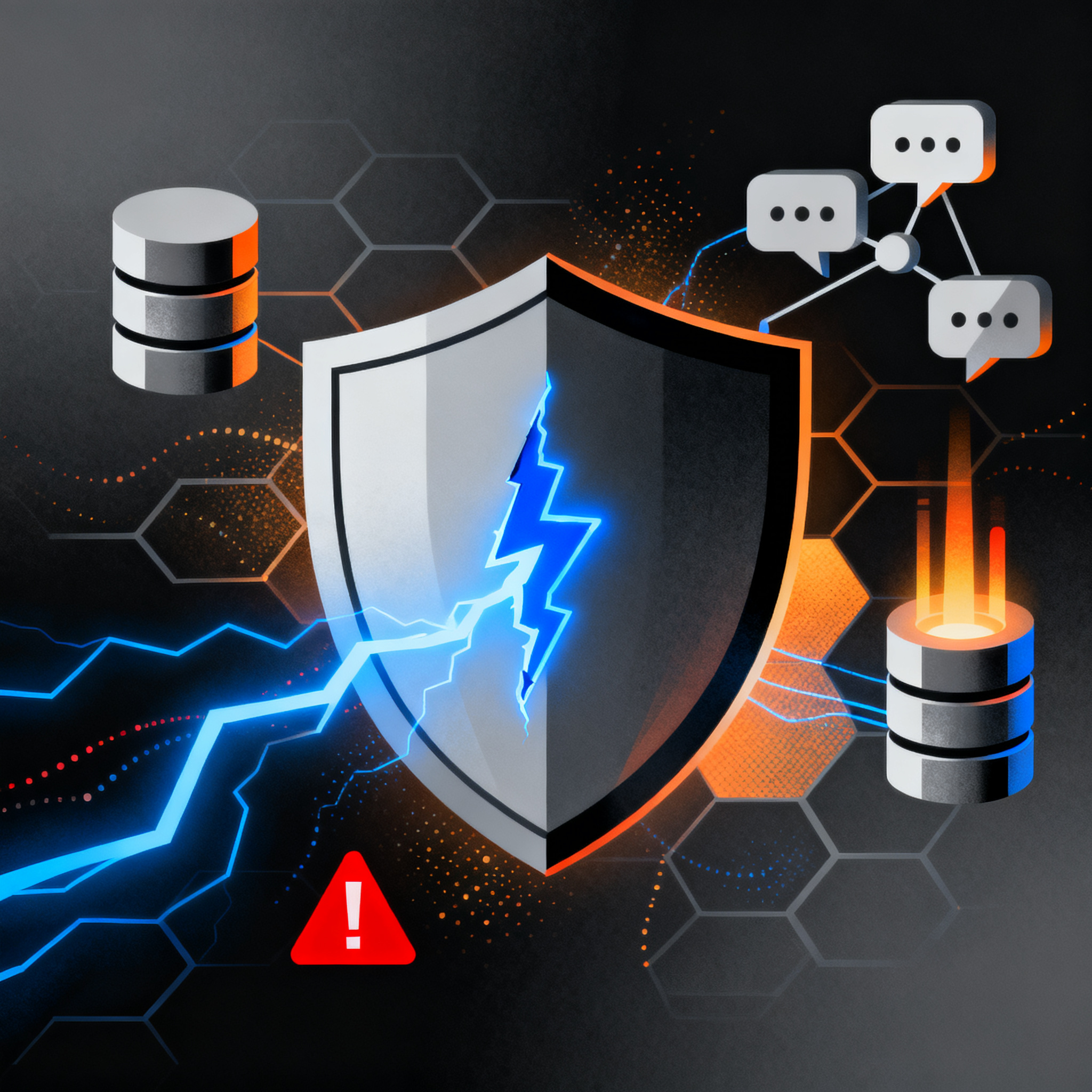
5 Critical Security Risks in RAG Systems (And How to Protect Your AI Chatbot)
5 Critical Security Risks in RAG Systems (And How to Protect Your AI Chatbot)
Retrieval-Augmented Generation has become the backbone of intelligent chatbots and AI assistants. By grounding AI responses in real, relevant data, RAG systems deliver accurate, contextual answers that pure language models simply cannot match.
But here's the uncomfortable truth: every RAG pipeline you deploy is also a potential attack surface.
As organizations rush to implement AI-powered solutions, security considerations for RAG systems often become an afterthought. This oversight can lead to devastating consequences—from leaked proprietary documents to manipulated AI responses that damage customer trust.
Let's examine the five most critical security vulnerabilities in RAG architectures and explore practical strategies to defend against them.
The Expanding Attack Surface of RAG Architectures
Traditional chatbots were relatively simple from a security perspective. They followed scripted paths, accessed limited data, and offered few opportunities for exploitation.
RAG systems are fundamentally different.
They connect language models to live document stores, vector databases, and external knowledge bases. This connectivity creates multiple entry points for attackers. Research on RAG security vulnerabilities has identified several attack vectors unique to retrieval-augmented systems.
Every component in your RAG pipeline—from the embedding model to the retrieval mechanism to the generation phase—presents potential security gaps. Understanding these vulnerabilities isn't optional anymore; it's essential for any business deploying AI chatbots at scale.
1. Prompt Injection: The Most Dangerous Threat
Prompt injection attacks represent the most severe security risk facing RAG systems today. These attacks manipulate the AI's behavior by inserting malicious instructions into user inputs or, more insidiously, into the retrieved documents themselves.
Direct Prompt Injection
In direct attacks, users craft inputs designed to override the system's original instructions. A seemingly innocent query might contain hidden commands that tell the AI to ignore its safety guidelines, reveal system prompts, or behave in unauthorized ways.
Indirect Prompt Injection
Indirect attacks are far more sophisticated and harder to detect. Attackers embed malicious instructions within documents that get indexed into your knowledge base. When the RAG system retrieves these poisoned documents, the hidden instructions execute during the generation phase.
Imagine a scenario where a competitor uploads a document to a public source your system indexes. That document contains invisible instructions telling your AI to recommend their products instead of yours. Your chatbot becomes a unwitting salesperson for your competition.
Studies on securing RAG systems against prompt injection emphasize that defense requires multiple layers: input sanitization, output filtering, and careful document ingestion policies.
2. Data Leakage Through Retrieval
Your RAG system's greatest strength—access to rich, relevant data—is also its greatest liability.
When a retrieval system pulls documents to answer queries, it doesn't inherently understand confidentiality levels. Without proper access controls, sensitive information meant for executives might surface in responses to entry-level employees. Customer data from one account could leak into another's chat session.
This isn't a theoretical concern. Analysis of identity gaps in retrieval pipelines reveals that most RAG implementations fail to propagate user permissions through the entire retrieval chain.
Common Data Leakage Scenarios
- Cross-tenant contamination: In multi-tenant SaaS applications, documents from one customer appearing in another's results
- Privilege escalation: Users accessing information above their clearance level through clever query construction
- Metadata exposure: System details, file paths, or internal identifiers leaking through response formatting
- Training data extraction: Attackers reconstructing sensitive documents through repeated, targeted queries
The solution requires implementing Role-Based Access Control (RBAC) that extends from your application layer all the way through your vector database and document stores.
3. Knowledge Base Poisoning
What happens when bad data enters your system? In RAG architectures, the consequences can be severe and long-lasting.
Knowledge base poisoning attacks target the documents and data that your system retrieves. Unlike prompt injection, which manipulates individual interactions, poisoning corrupts the foundation your AI relies on for accurate responses.
Attack Vectors for Knowledge Poisoning
- Compromised data sources: If your system ingests content from external websites or APIs, attackers can modify those sources
- Insider threats: Employees with document upload privileges inserting misleading information
- Supply chain attacks: Compromised third-party integrations introducing malicious content
Research published on RAG security frameworks highlights that organizations often lack visibility into what content exists in their knowledge bases and when it was modified.
Defending against poisoning requires comprehensive document provenance tracking, regular audits of your knowledge base, and strict controls over who can add or modify indexed content.
4. Model Manipulation and Output Integrity
Even with clean data and sanitized inputs, the generation phase of RAG systems presents security challenges.
Attackers may attempt to manipulate how your model interprets retrieved context or formats its responses. These attacks can result in:
- Hallucinated citations: The AI referencing documents that don't exist or misquoting real sources
- Instruction leakage: System prompts or configuration details appearing in user-facing responses
- Harmful content generation: Bypassing safety filters through carefully constructed retrieval contexts
Comprehensive analysis of RAG security considerations emphasizes the importance of output validation layers that check responses before they reach users.
Building Output Integrity
Effective output security involves multiple checkpoints:
- Content filtering: Scanning generated responses for sensitive patterns, PII, or prohibited content
- Citation verification: Confirming that referenced sources actually exist and support the claims made
- Consistency checking: Ensuring responses align with established organizational messaging and policies
- Anomaly detection: Flagging unusual response patterns that might indicate successful attacks
5. Infrastructure and Access Control Vulnerabilities
The final security consideration extends beyond the RAG system itself to the infrastructure supporting it.
Vector databases, embedding APIs, document stores, and orchestration layers all require proper security configurations. A single misconfigured endpoint can expose your entire knowledge base.
Critical Infrastructure Security Measures
- API authentication: Ensuring all components communicate through authenticated, encrypted channels
- Network segmentation: Isolating RAG components from public-facing infrastructure
- Secret management: Properly securing API keys, database credentials, and encryption keys
- Audit logging: Maintaining comprehensive logs of all retrieval and generation activities
Academic research on RAG system vulnerabilities consistently finds that infrastructure misconfigurations account for a significant percentage of successful attacks.
The Compliance Dimension
Security considerations for RAG systems extend into regulatory compliance. Depending on your industry and geography, your AI chatbot may need to satisfy requirements from:
- GDPR: Right to erasure applies to data in your knowledge base
- HIPAA: Healthcare information requires specific handling and access controls
- SOC 2: Service organization controls covering availability, security, and confidentiality
- Industry-specific regulations: Financial services, legal, and government sectors face additional requirements
Building compliant RAG systems means implementing data retention policies, access audit trails, and the ability to identify and remove specific user data from your knowledge base on request.
The Build vs. Buy Security Dilemma
At this point, the complexity becomes clear. Securing a RAG system isn't a single task—it's an ongoing commitment spanning:
- Input validation and sanitization
- Document ingestion controls
- Role-based access control propagation
- Output filtering and verification
- Infrastructure hardening
- Continuous monitoring and incident response
- Compliance documentation and auditing
Building these security layers from scratch requires deep expertise across AI systems, application security, and compliance frameworks. Most teams significantly underestimate the effort involved.
For organizations looking to deploy secure AI chatbots without reinventing security infrastructure, purpose-built solutions offer a faster path to production.
Launching Secure RAG Applications with ChatRAG
ChatRAG provides a production-ready foundation for building secure AI chatbot businesses. Instead of spending months implementing security controls, you inherit a battle-tested architecture designed with these considerations built in.
The platform's Add-to-RAG functionality includes document provenance tracking and ingestion controls. Multi-tenant isolation ensures customer data remains separated. And with support for 18 languages and embeddable widgets, you can deploy globally while maintaining consistent security standards.
Whether you're building customer support automation, internal knowledge assistants, or AI-powered SaaS products, starting with a secure foundation lets you focus on what makes your application unique—not on reinventing security infrastructure.
Key Takeaways
RAG systems transform what's possible with AI chatbots, but they introduce security challenges that demand serious attention:
- Prompt injection threatens both direct user inputs and indexed documents
- Data leakage through retrieval requires end-to-end access control propagation
- Knowledge base poisoning can corrupt your AI's responses at the source
- Output integrity requires validation layers before responses reach users
- Infrastructure security extends to every component in your RAG pipeline
The organizations that succeed with AI chatbots will be those that treat security as a foundational requirement—not an afterthought. Whether you build custom solutions or leverage platforms like ChatRAG, prioritizing security protects both your business and your users.
Ready to build your AI chatbot SaaS?
ChatRAG provides the complete Next.js boilerplate to launch your chatbot-agent business in hours, not months.
Get ChatRAGRelated Articles

7 Critical Security Considerations for RAG Systems (And How to Address Them)
As RAG systems become the backbone of enterprise AI, security vulnerabilities are emerging as a critical concern. Understanding these risks—from prompt injection attacks to unauthorized data access—is essential for any organization deploying retrieval-augmented generation technology.

What is RAG and How Does It Work? 5 Key Components That Power Modern AI Chatbots
Retrieval-Augmented Generation (RAG) is transforming how businesses build AI chatbots by combining the power of large language models with real-time access to your own data. Learn how this architecture works and why it's become the gold standard for enterprise AI applications.

5 Steps to Build a Chatbot with Your Company Knowledge Base (Without Losing Your Mind)
Your company knowledge base is a goldmine of information—but only if people can find what they need. Here's how to transform static documentation into an intelligent chatbot that delivers instant, accurate answers.