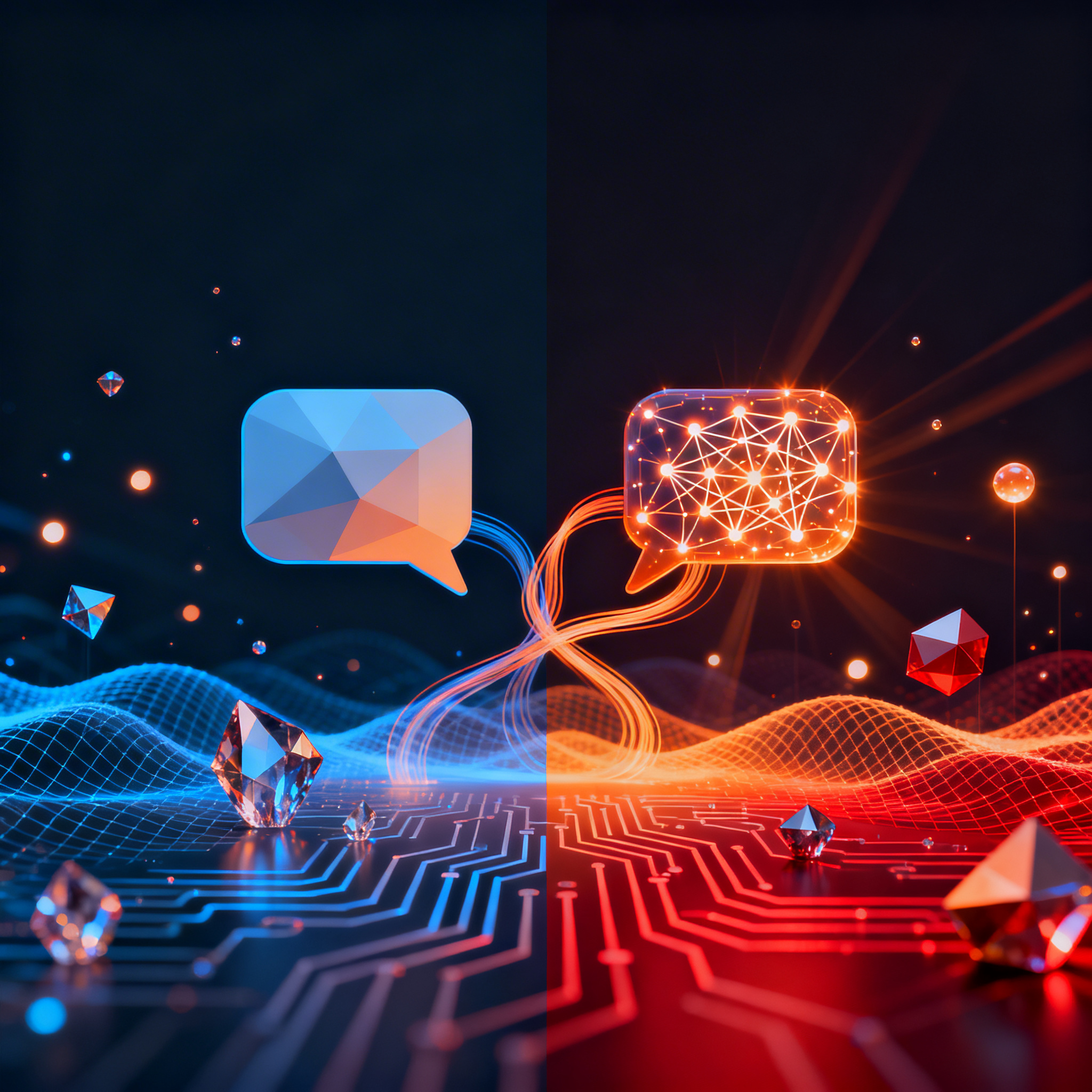
AI Chatbots vs Regular Chatbots: 5 Critical Differences That Impact Your Business in 2025
AI Chatbots vs Regular Chatbots: 5 Critical Differences That Impact Your Business in 2025
You've probably interacted with both types without even realizing it.
One chatbot understands when you say "I'm locked out of my account" and immediately offers password reset options, account recovery, and security verification—all in one seamless flow.
The other responds with "I didn't understand that. Please choose from the following options: 1) Billing, 2) Technical Support, 3) Sales."
The difference between AI chatbots and regular chatbots isn't subtle. It's the difference between a conversation and a phone tree. Between solving problems and creating new ones.
As businesses race to automate customer interactions, understanding the distinction between AI-powered and traditional chatbots has become essential for making the right technology investment.
Let's break down what actually separates these two approaches—and why it matters for your bottom line.
What Are Regular (Rule-Based) Chatbots?
Traditional chatbots, often called rule-based or scripted chatbots, operate on a simple principle: if-then logic.
They follow predetermined conversation flows created by developers. When a user types a specific keyword or phrase, the bot responds with a pre-written answer. Think of them as sophisticated decision trees.
How rule-based chatbots work:
- Match user input against a library of keywords
- Follow scripted conversation paths
- Provide predetermined responses
- Escalate to humans when they hit dead ends
These chatbots excel in narrow, well-defined scenarios. Checking order status? Perfect. Providing business hours? Flawless. But ask something slightly outside their script, and they crumble.
The limitation isn't intelligence—it's flexibility. Rule-based bots can only handle what they've been explicitly programmed to handle.
What Are AI Chatbots?
AI chatbots represent a fundamental architectural shift in how machines process and respond to human language.
Rather than matching keywords to scripts, AI chatbots use natural language processing (NLP) and machine learning to understand intent, context, and nuance. They don't just recognize words—they comprehend meaning.
Core capabilities of AI chatbots:
- Understand natural language variations and colloquialisms
- Learn from interactions to improve over time
- Handle complex, multi-turn conversations
- Generate contextually appropriate responses
- Recognize sentiment and emotional cues
When you tell an AI chatbot "My package never showed up," it understands you're reporting a missing delivery—even though you never used the word "delivery" or "tracking."
That's the power of intent recognition.
The 5 Critical Differences That Matter
1. Understanding vs. Matching
Rule-based chatbots match patterns. AI chatbots understand meaning.
This distinction becomes obvious when users don't follow the script. A traditional bot might recognize "cancel subscription" but fail on "I don't want to pay for this anymore" or "stop charging my card."
AI chatbots connect these variations to the same underlying intent. They understand that language is messy, inconsistent, and deeply human.
According to recent analysis on chatbot architecture, this understanding capability alone can increase successful conversation resolution by 40% or more.
2. Static vs. Adaptive Learning
Traditional chatbots stay exactly as smart as the day they launched.
Every improvement requires manual intervention—developers must identify gaps, write new scripts, and deploy updates. It's a constant game of whack-a-mole.
AI chatbots learn continuously. They analyze conversation patterns, identify common failure points, and adapt their responses accordingly. The more conversations they handle, the smarter they become.
This creates a compounding advantage over time. While rule-based bots degrade as customer language evolves, AI bots improve.
3. Linear vs. Dynamic Conversations
Have you ever been trapped in a chatbot loop? Asked a question, received an irrelevant response, tried to clarify, and ended up back at the main menu?
That's the limitation of linear conversation design. Rule-based bots follow predetermined paths. Deviate from the expected flow, and the whole interaction breaks down.
AI chatbots handle dynamic, non-linear conversations naturally. Users can jump between topics, provide information out of order, or change their minds mid-conversation. The bot maintains context and adapts accordingly.
This flexibility mirrors how humans actually communicate—which is rarely in neat, sequential steps.
4. Knowledge Retrieval vs. Knowledge Integration
Here's where things get interesting.
Traditional chatbots access information through rigid database queries. Ask about a specific product, and they'll retrieve that product's data. Ask a comparative question, and they're lost.
Modern AI chatbots leverage something called Retrieval-Augmented Generation (RAG). They don't just retrieve information—they synthesize it.
Ask an AI chatbot "Which laptop is best for video editing under $1500?" and it can:
- Search across your entire product catalog
- Compare specifications relevant to video editing
- Filter by price constraints
- Generate a personalized recommendation
This knowledge integration capability transforms chatbots from simple FAQ tools into genuine virtual advisors.
5. Action vs. Talk
Perhaps the most significant evolution: the shift from conversation to action.
Traditional chatbots talk about solutions. AI chatbots—especially those evolving into AI agents—actually implement them.
Need to reschedule a delivery? An AI chatbot can access the logistics system, check available windows, update the schedule, and confirm the change—all within the same conversation.
This action-oriented capability represents the next frontier of conversational AI. It's not just about answering questions anymore. It's about solving problems autonomously.
When Rule-Based Chatbots Still Make Sense
Despite the advantages of AI, traditional chatbots aren't obsolete.
They remain excellent choices for:
- Simple, high-volume queries with predictable formats
- Strict compliance environments requiring exact scripted responses
- Limited budgets where AI infrastructure isn't feasible
- Quick deployment needs with narrow use cases
If 90% of your customer inquiries fall into five categories with straightforward answers, a well-designed rule-based bot might serve you perfectly.
The key is honest assessment of your actual needs—not chasing technology for its own sake.
When AI Chatbots Become Essential
Conversely, AI chatbots become necessary when:
- Customer inquiries vary significantly in phrasing and complexity
- You need to handle multi-turn conversations with context retention
- Your knowledge base is large and requires intelligent search
- You want the bot to take actions, not just provide information
- Customer experience is a competitive differentiator
For SaaS companies, e-commerce platforms, and service businesses with diverse customer needs, AI chatbots have moved from nice-to-have to essential infrastructure.
The Hidden Complexity of Building AI Chatbots
Here's what the comparison articles don't always mention: building production-ready AI chatbots is genuinely hard.
The technology stack alone is daunting. You need:
- Natural language processing infrastructure
- Knowledge base integration and RAG pipelines
- Conversation state management
- Multi-channel deployment (web, mobile, WhatsApp, embeds)
- User authentication and data security
- Analytics and continuous improvement systems
- Payment processing if you're monetizing
Each component requires specialized expertise. Integrating them into a cohesive system multiplies the complexity exponentially.
Many teams spend 6-12 months building chatbot infrastructure before writing a single line of business logic.
The Build vs. Buy Decision
This complexity creates a strategic question: should you build your AI chatbot infrastructure from scratch, or start with a foundation designed for this purpose?
Building from scratch offers maximum control but demands significant resources. You'll need AI/ML engineers, full-stack developers, DevOps expertise, and considerable time.
Starting with purpose-built infrastructure lets you focus on what actually differentiates your product—the conversations, the knowledge, the customer experience.
ChatRAG represents this second approach. It's a complete Next.js boilerplate specifically designed for launching chatbot and AI agent SaaS products.
Rather than spending months on authentication, RAG pipelines, payment integration, and multi-channel deployment, you get production-ready infrastructure from day one.
Features like Add-to-RAG (letting users expand the knowledge base through conversation), support for 18 languages, and embeddable widgets for any website mean you can launch a sophisticated AI chatbot product in weeks, not quarters.
Key Takeaways
The difference between AI chatbots and regular chatbots comes down to understanding versus matching, adaptation versus rigidity, and action versus conversation.
Remember these distinctions:
- Rule-based bots follow scripts; AI bots comprehend intent
- Traditional bots stay static; AI bots learn continuously
- Scripted conversations are linear; AI conversations flow naturally
- Basic bots retrieve data; AI bots synthesize knowledge
- Regular chatbots talk; AI chatbots act
The right choice depends on your specific needs, resources, and customer expectations. But as user expectations rise and AI technology matures, the balance increasingly favors intelligent, adaptive systems.
Whether you build or buy, the important thing is starting with clear understanding of what each approach offers—and what it demands.
The chatbot landscape has evolved dramatically. Make sure your strategy evolves with it.
Build your own RAG chatbot
ChatRAG is a free, open-source Next.js platform for RAG-powered chatbots. Clone it, brand it, and ship it to your clients.
Get it on GitHubRelated Articles
7 Essential Steps to Build a Customer Service Chatbot That Actually Works
Customer service chatbots have evolved from frustrating dead-ends to powerful AI agents that resolve issues instantly. Here's how to build one that customers will actually want to use—and the critical decisions that separate success from failure.
7 Steps to Build a Customer Service Chatbot That Actually Resolves Issues
Customer service chatbots have evolved from frustrating menu trees to intelligent agents that resolve issues autonomously. Here's a strategic guide to building one that customers will actually want to use—and that delivers real ROI for your business.
5 Ways RAG Transforms Customer Service Chatbot Automation in 2025
Customer service teams are drowning in tickets while customers demand instant, accurate responses. Retrieval-Augmented Generation (RAG) is emerging as the breakthrough technology that bridges this gap—combining the knowledge of your entire support library with the conversational intelligence of modern AI.