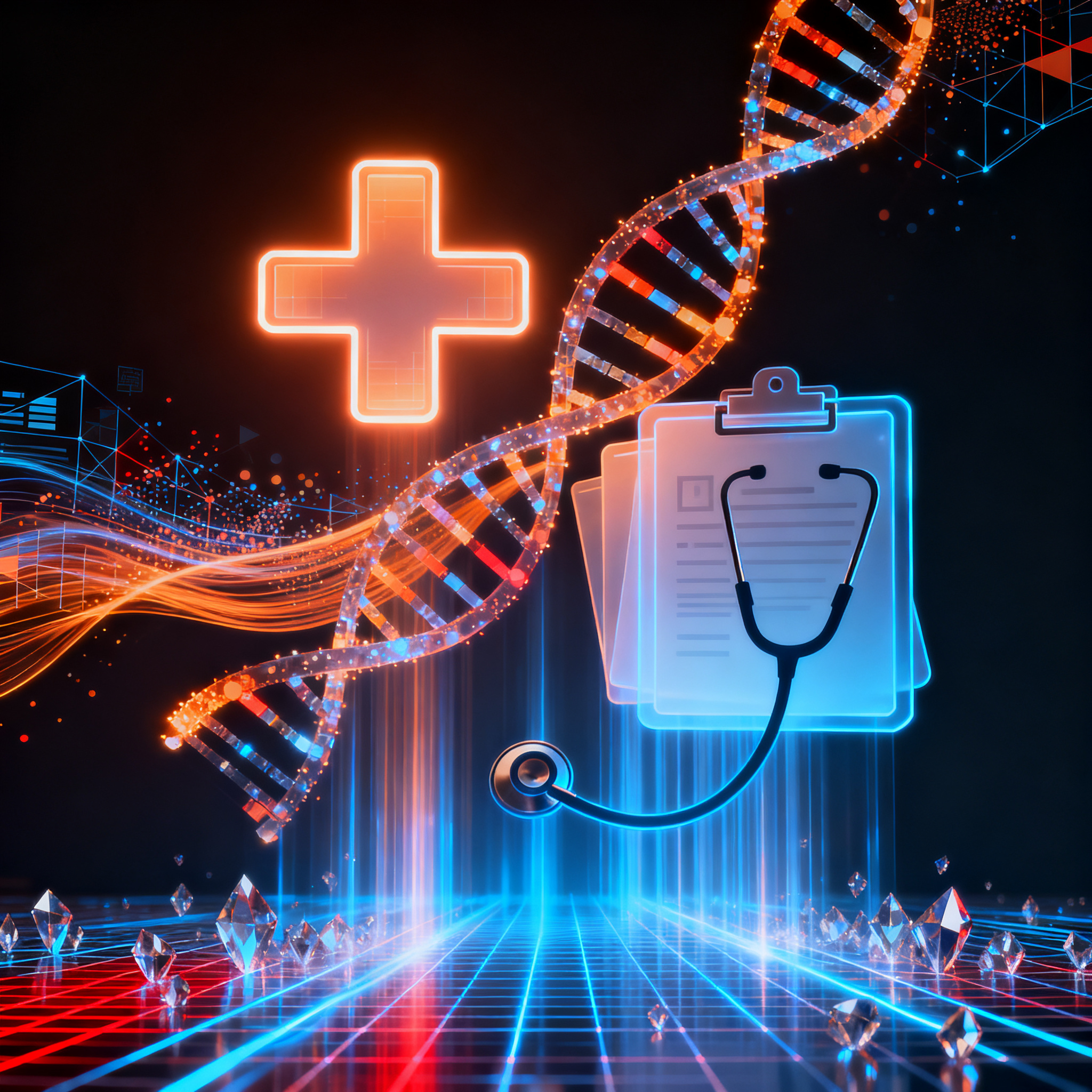
5 Ways RAG Is Transforming Healthcare Patient Record Management in 2025
5 Ways RAG Is Transforming Healthcare Patient Record Management in 2025
The average physician spends nearly two hours on EHR documentation for every hour of direct patient care. That's not a typo—it's a crisis.
Electronic Health Records were supposed to streamline healthcare. Instead, they've created a labyrinth of fragmented data, endless scrolling, and alert fatigue. Clinicians are burning out, critical information gets buried, and patients suffer the consequences.
But a quiet revolution is underway. RAG for healthcare patient record management is emerging as the most promising solution to this decade-old problem—and forward-thinking health systems are already seeing results.
The Patient Record Problem Nobody Talks About
Here's what happens in a typical hospital today: A patient arrives in the emergency department with chest pain. Their medical history spans 15 years, three health systems, and thousands of discrete data points.
The attending physician has roughly 7 minutes to make sense of it all.
They need to know about previous cardiac events, current medications, allergies, recent lab results, and family history. That information exists—scattered across progress notes, discharge summaries, imaging reports, and consultation records.
Most of it never gets seen.
Research into clinical reasoning over electronic health records has shown that even the most sophisticated AI systems struggle with the sheer volume and complexity of longitudinal patient data. Traditional keyword search falls short. Manual review is impossible at scale.
This is precisely where RAG changes everything.
What Makes RAG Different for Healthcare
Retrieval-Augmented Generation isn't just another AI buzzword. It's a fundamentally different approach to how machines interact with medical information.
Traditional language models generate responses based on their training data—which may be outdated, incomplete, or simply wrong for your specific patient population. RAG systems, by contrast, retrieve relevant information from your actual patient records before generating any response.
The difference is profound:
- Grounded responses: Every answer traces back to specific documents in the patient's chart
- Real-time relevance: The system works with current data, not historical training sets
- Reduced hallucination: By anchoring to retrieved documents, RAG dramatically reduces the risk of fabricated medical information
Studies on retrieval-augmented generation in healthcare have demonstrated significant improvements in accuracy compared to standalone language models—particularly for complex clinical queries that require synthesizing information across multiple encounters.
5 Transformative Applications in Patient Record Management
1. Intelligent Discharge Question Answering
Discharge is one of the highest-risk moments in patient care. Miscommunication about medications, follow-up appointments, or warning signs leads to preventable readmissions.
RAG-powered systems are now enabling patients and caregivers to ask natural language questions about their discharge instructions—and receive accurate, personalized answers drawn directly from their medical records.
Research on experience retrieval-augmentation with electronic health records shows these systems can accurately answer complex discharge-related questions by retrieving relevant clinical context before generating responses.
Instead of generic pamphlets, patients get answers like: "Based on your surgery notes, you should avoid lifting anything over 10 pounds for the next 6 weeks. Your surgeon, Dr. Martinez, noted this specifically in your post-operative instructions."
2. Longitudinal Patient History Synthesis
The most valuable clinical insights often emerge from patterns across time—a slowly declining kidney function, a recurring complaint that was dismissed, a medication that was tried and failed years ago.
Traditional EHR interfaces make longitudinal analysis nearly impossible. Clinicians would need to click through dozens of encounters to piece together the story.
New multi-stage retrieval pipelines for longitudinal EHR question answering are solving this challenge. These systems can intelligently traverse years of patient data, identify relevant clinical events, and synthesize coherent narratives that would take humans hours to compile.
A cardiologist can now ask: "What interventions have been tried for this patient's hypertension over the past five years, and what were the outcomes?" The system retrieves relevant encounters, extracts medication changes and blood pressure readings, and presents a clear clinical timeline.
3. Similar Patient Case Retrieval
Medicine has always relied on pattern recognition. Experienced clinicians draw on thousands of previous cases when evaluating a new patient.
RAG systems are now democratizing this expertise. By retrieving similar cases from institutional databases, they help clinicians—especially those early in their careers—benefit from collective experience.
MED-COPILOT and similar graph-based RAG approaches can identify patients with similar presentations, comorbidities, and treatment trajectories. This isn't about replacing clinical judgment—it's about augmenting it with relevant precedents.
When a resident encounters an unusual presentation, they can query: "Show me similar cases of young patients with unexplained syncope and normal initial workup." The system retrieves de-identified cases that ultimately revealed rare diagnoses, prompting consideration of tests that might otherwise be overlooked.
4. Safe Clinical Question Answering
Patient safety is non-negotiable in healthcare AI. Any system that interacts with clinical data must be demonstrably safe, auditable, and transparent.
This is why hybrid graph RAG approaches for safe clinical AI are gaining traction. By combining retrieval with structured knowledge graphs, these systems can:
- Provide citations for every claim
- Flag when confidence is low
- Escalate to human review when appropriate
- Maintain complete audit trails
The goal isn't autonomous decision-making. It's intelligent information retrieval that keeps clinicians in control while dramatically reducing their cognitive burden.
5. Multi-Modal Record Integration
Patient records aren't just text. They include imaging studies, waveform data, pathology slides, and structured lab results.
Advanced RAG systems are beginning to integrate these diverse data types, allowing clinicians to ask questions that span modalities: "Has this patient's chest X-ray appearance changed since their last admission?" or "How do the current lab trends compare to their previous hospitalization?"
This multi-modal capability transforms RAG from a document search tool into a comprehensive clinical intelligence layer.
The Architecture That Makes It Work
Building RAG for healthcare isn't simply about connecting a language model to a database. The architecture must address healthcare-specific challenges:
Chunking strategies matter: Medical documents have unique structures. A progress note reads differently than a pathology report. Effective RAG systems use domain-aware chunking that preserves clinical context.
Embedding models need medical training: General-purpose embeddings miss crucial medical relationships. Systems trained on clinical text understand that "MI" and "heart attack" and "myocardial infarction" should retrieve similar content.
Retrieval must be multi-hop: Clinical questions often require connecting information across multiple documents. A question about medication interactions might need to retrieve the current med list, recent lab values, and relevant clinical notes—then synthesize across all three.
Governance is essential: Healthcare data is among the most regulated in any industry. RAG systems must maintain HIPAA compliance, role-based access controls, and comprehensive audit logging.
The Implementation Reality Check
If the potential of RAG for patient records is so clear, why isn't every health system using it?
The answer lies in implementation complexity.
Building a production-ready RAG system for healthcare requires:
- Secure infrastructure that meets healthcare compliance requirements
- Sophisticated document processing pipelines for diverse EHR formats
- Vector databases optimized for medical terminology
- Integration with existing clinical workflows
- Multi-language support for diverse patient populations
- Audit trails and explainability features
Most health IT teams are already stretched thin. Building this infrastructure from scratch—while maintaining existing systems—is a multi-year, multi-million dollar undertaking.
And that's before addressing the AI components themselves: model selection, prompt engineering, retrieval optimization, and continuous evaluation.
A Faster Path to Healthcare RAG
The organizations seeing success with RAG for patient records aren't necessarily those with the biggest budgets. They're the ones building on foundations designed for exactly this use case.
Modern boilerplate platforms now exist that provide the core RAG infrastructure out of the box—document ingestion, vector storage, retrieval optimization, and conversational interfaces—allowing healthcare innovators to focus on their domain expertise rather than reinventing technical infrastructure.
ChatRAG represents this new generation of development platforms. Built specifically for RAG-powered applications, it provides the authentication, payment processing, multi-channel deployment, and document processing capabilities that healthcare AI products require.
The platform's Add-to-RAG functionality allows clinical teams to continuously expand their knowledge bases as new protocols, guidelines, and institutional knowledge emerge. Support for 18 languages addresses the reality of diverse patient populations. And embeddable widgets mean RAG capabilities can be deployed within existing clinical portals rather than requiring workflow disruption.
Key Takeaways
RAG for healthcare patient record management isn't a future possibility—it's a present reality that's already improving clinical workflows and patient outcomes.
The technology addresses fundamental challenges that have plagued EHR systems since their inception: information overload, fragmented data, and the impossible task of synthesizing years of medical history in minutes.
Success requires thoughtful implementation that prioritizes safety, maintains clinician control, and integrates with existing workflows. It requires infrastructure that meets healthcare's stringent compliance requirements while remaining flexible enough to evolve with rapidly advancing AI capabilities.
For organizations ready to bring RAG to their patient record systems, the question is no longer whether to proceed—but how to get there efficiently. Platforms like ChatRAG are making that journey dramatically shorter, providing the production-ready foundation that lets healthcare innovators focus on what matters most: improving patient care.
The two-hour documentation burden doesn't have to be permanent. The future of healthcare AI is retrieval-augmented, clinician-centered, and closer than you think.
Ready to build your AI chatbot SaaS?
ChatRAG provides the complete Next.js boilerplate to launch your chatbot-agent business in hours, not months.
Get ChatRAGRelated Articles
5 Steps to Build a Customer Service Chatbot That Actually Solves Problems in 2026
Customer service chatbots have evolved from frustrating dead-ends to intelligent agents that resolve issues autonomously. Here's how to build one that customers will actually appreciate—and that scales with your business.
5 Essential Steps to Implement RAG in Your Application (Without the Headaches)
Retrieval-Augmented Generation has moved from experimental to essential. Here's your strategic roadmap to implementing RAG in your application—and why building from scratch might not be your smartest move.

5 Ways RAG is Transforming Cybersecurity Threat Intelligence Analysis in 2025
Security operations centers are drowning in threat data while attackers move faster than ever. Retrieval-Augmented Generation is emerging as the critical bridge between overwhelming threat intelligence feeds and actionable security insights that actually protect organizations.