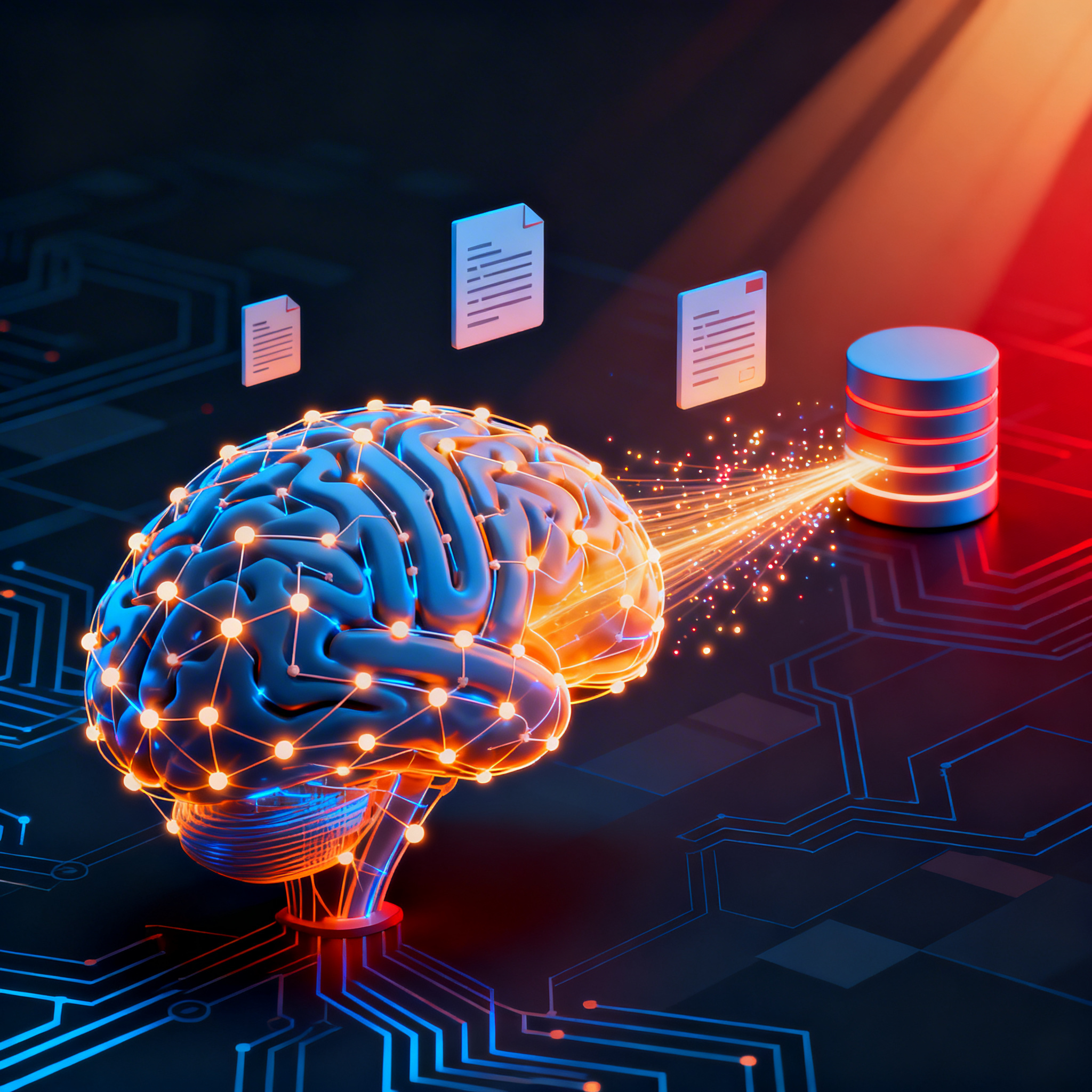
What is RAG? 5 Key Components That Make AI Chatbots Actually Useful
What is RAG? 5 Key Components That Make AI Chatbots Actually Useful
You've probably experienced it: asking an AI chatbot a specific question about your company's policies, only to receive a confident but completely fabricated answer. This phenomenon—called hallucination—has been the Achilles' heel of large language models since their inception.
Enter Retrieval-Augmented Generation, or RAG. This architectural approach has become the foundation for building AI systems that don't just sound intelligent but actually are intelligent about your specific domain.
But what exactly is RAG, and why has it become the gold standard for enterprise AI applications?
The Problem RAG Was Designed to Solve
Large language models like GPT-4, Claude, and Llama are trained on massive datasets, giving them impressive general knowledge. However, they suffer from three critical limitations:
- Knowledge cutoff: Their training data has a fixed date, making them unaware of recent events or updates
- No access to private data: They can't know about your internal documents, products, or processes
- Hallucination tendency: When uncertain, they often generate plausible-sounding but incorrect information
For businesses building customer-facing chatbots or internal knowledge assistants, these limitations aren't just inconvenient—they're dealbreakers.
Imagine deploying a support chatbot that confidently tells customers your return policy is 30 days when it's actually 14. Or an internal assistant that provides outdated compliance procedures to employees.
RAG solves these problems by grounding AI responses in your actual data.
How Retrieval-Augmented Generation Works
At its core, RAG combines two powerful capabilities: the ability to search through relevant documents (retrieval) and the ability to generate natural language responses (generation). The "augmented" part refers to how retrieved information enhances the generation process.
Here's the high-level flow:
- A user asks a question
- The system searches your knowledge base for relevant information
- Retrieved context is combined with the original question
- The LLM generates a response grounded in that specific context
- The user receives an accurate, contextually appropriate answer
This seemingly simple architecture represents a fundamental shift in how we build AI applications. Instead of relying solely on what a model learned during training, we're giving it real-time access to authoritative information.
The 5 Core Components of a RAG System
Understanding RAG requires breaking it down into its essential building blocks. According to recent academic research on RAG architectures, modern systems typically consist of five interconnected components.
1. Document Ingestion Pipeline
Before RAG can work, your knowledge must be processed and stored in a searchable format. This involves:
- Document parsing: Extracting text from PDFs, web pages, databases, and other sources
- Chunking: Breaking documents into smaller, semantically meaningful pieces
- Metadata extraction: Capturing information like titles, dates, and categories for filtering
The quality of your ingestion pipeline directly impacts retrieval accuracy. Poorly chunked documents lead to incomplete or irrelevant context being passed to the LLM.
2. Embedding Model
Raw text can't be searched semantically—computers need numerical representations. Embedding models convert text chunks into dense vectors that capture meaning.
When two pieces of text discuss similar concepts, their embeddings will be mathematically close together, even if they use different words. This enables semantic search rather than simple keyword matching.
For example, "return policy" and "how to send items back" would have similar embeddings despite sharing no words.
3. Vector Database
These specialized databases store embeddings and enable lightning-fast similarity searches across millions of documents. When a query comes in, the vector database finds the most semantically similar chunks in milliseconds.
Popular options include Pinecone, Weaviate, and Qdrant, though many modern platforms abstract this complexity away entirely.
4. Retrieval Strategy
Not all retrieval is created equal. Comprehensive guides to RAG implementation distinguish between several approaches:
- Naive RAG: Simple top-k similarity search
- Advanced RAG: Incorporates re-ranking, query expansion, and hybrid search
- Agentic RAG: Uses AI agents to dynamically decide what and how to retrieve
The right strategy depends on your use case. Simple FAQ bots might work fine with naive RAG, while complex research assistants benefit from agentic approaches.
5. Generation Layer
Finally, the LLM synthesizes retrieved information into a coherent response. This isn't simple copy-paste—the model must:
- Identify relevant portions of the retrieved context
- Resolve potential contradictions between sources
- Generate natural language that answers the specific question
- Cite sources when appropriate
Modern RAG systems often include guardrails at this stage to prevent the model from straying beyond the provided context.
Why RAG Outperforms Fine-Tuning
When organizations want domain-specific AI, they often consider fine-tuning—retraining a model on their data. While fine-tuning has its place, RAG offers several advantages for most business applications:
Cost efficiency: Fine-tuning requires significant computational resources and expertise. RAG works with off-the-shelf models.
Real-time updates: When your documentation changes, RAG systems reflect updates immediately. Fine-tuned models require retraining.
Transparency: RAG can cite specific sources for its answers, enabling verification. Fine-tuned models provide no such traceability.
Reduced hallucination: By grounding responses in retrieved documents, RAG dramatically reduces fabricated information.
For most SaaS applications—customer support, knowledge management, internal assistants—RAG provides the best balance of accuracy, cost, and maintainability.
Real-World RAG Applications
The versatility of RAG has led to adoption across industries:
Customer Support Automation
Companies deploy RAG-powered chatbots that can accurately answer questions about products, policies, and procedures by retrieving information from help centers, documentation, and knowledge bases.
Legal and Compliance
Law firms use RAG to search through case law, contracts, and regulatory documents, generating summaries and identifying relevant precedents.
Healthcare Information
Medical institutions implement RAG systems that help staff quickly find protocol information, drug interactions, and treatment guidelines from trusted sources.
Internal Knowledge Management
Enterprises build "ask anything" interfaces that search across wikis, Confluence pages, Slack history, and documents to help employees find information instantly.
E-commerce Product Discovery
Online retailers use RAG to power conversational shopping assistants that understand natural language queries and retrieve relevant product information.
The Evolution Toward Agentic RAG
The field isn't standing still. Research into agentic RAG architectures shows a clear evolution toward more sophisticated systems.
Traditional RAG follows a fixed retrieve-then-generate pattern. Agentic RAG introduces AI agents that can:
- Decide whether retrieval is necessary for a given query
- Choose which knowledge sources to search
- Perform multiple retrieval rounds to gather comprehensive information
- Use tools to fetch real-time data from APIs
- Self-correct when initial retrieval proves insufficient
This represents the next frontier for enterprise AI assistants—systems that don't just answer questions but actively reason about how to find the best answers.
The Hidden Complexity of Production RAG
Here's what the tutorials don't tell you: building a proof-of-concept RAG system takes a weekend. Building a production-ready RAG application takes months.
Consider everything a real-world RAG-powered chatbot needs:
- Multi-format document processing: PDFs, web pages, images, databases
- Scalable vector storage: Handling millions of documents efficiently
- Authentication and access control: Ensuring users only access authorized information
- Multi-channel deployment: Web widgets, mobile apps, WhatsApp, Slack
- Analytics and monitoring: Understanding what users ask and how well the system performs
- Billing and subscription management: Monetizing your AI product
- Multilingual support: Serving global audiences
- Continuous improvement: Adding new documents and refining retrieval
Each of these represents a significant engineering effort. For teams building AI-powered SaaS products, the infrastructure work can easily overshadow the actual innovation.
Building RAG Applications Without the Infrastructure Burden
This is precisely why platforms like ChatRAG have emerged. Rather than spending months building authentication, payment processing, document ingestion, and deployment infrastructure, teams can focus on what makes their application unique.
ChatRAG provides the complete RAG stack pre-built and production-ready. Features like Add-to-RAG let users expand their knowledge base on the fly, while native support for 18 languages ensures global reach from day one. The embeddable widget means you can deploy intelligent chatbots anywhere—your marketing site, customer portal, or internal tools.
For founders and developers who want to launch RAG-powered products without reinventing the wheel, having this infrastructure already solved isn't just convenient—it's the difference between launching in weeks versus quarters.
Key Takeaways
Retrieval-Augmented Generation has fundamentally changed what's possible with AI applications. By grounding language models in authoritative, up-to-date information, RAG enables chatbots and assistants that are actually useful for business.
The core architecture—document ingestion, embeddings, vector search, retrieval strategies, and generation—works together to deliver accurate, contextual responses. And as the field evolves toward agentic approaches, these systems will only become more capable.
The question isn't whether to use RAG for your AI products. It's whether you'll build the infrastructure yourself or leverage platforms purpose-built for this exact challenge.
The technology is ready. The market is ready. The only question is how quickly you can get your RAG-powered product into users' hands.
Ready to build your AI chatbot SaaS?
ChatRAG provides the complete Next.js boilerplate to launch your chatbot-agent business in hours, not months.
Get ChatRAGRelated Articles

What is RAG and How Does It Work? 5 Key Components That Power Modern AI Chatbots
Retrieval-Augmented Generation (RAG) is transforming how businesses build AI chatbots by combining the power of large language models with real-time access to your own data. Learn how this architecture works and why it's become the gold standard for enterprise AI applications.
What is Retrieval Augmented Generation? A Beginner's Guide to Smarter AI
Retrieval Augmented Generation (RAG) is revolutionizing how AI systems access and use information. This beginner's guide breaks down what RAG is, why it matters, and how it's making AI chatbots dramatically more accurate and useful for businesses.

5 Ways RAG Transforms Customer Service Chatbot Automation in 2025
Customer service teams are drowning in tickets while customers demand instant, accurate responses. Retrieval-Augmented Generation (RAG) is emerging as the breakthrough technology that bridges this gap—combining the knowledge of your entire support library with the conversational intelligence of modern AI.