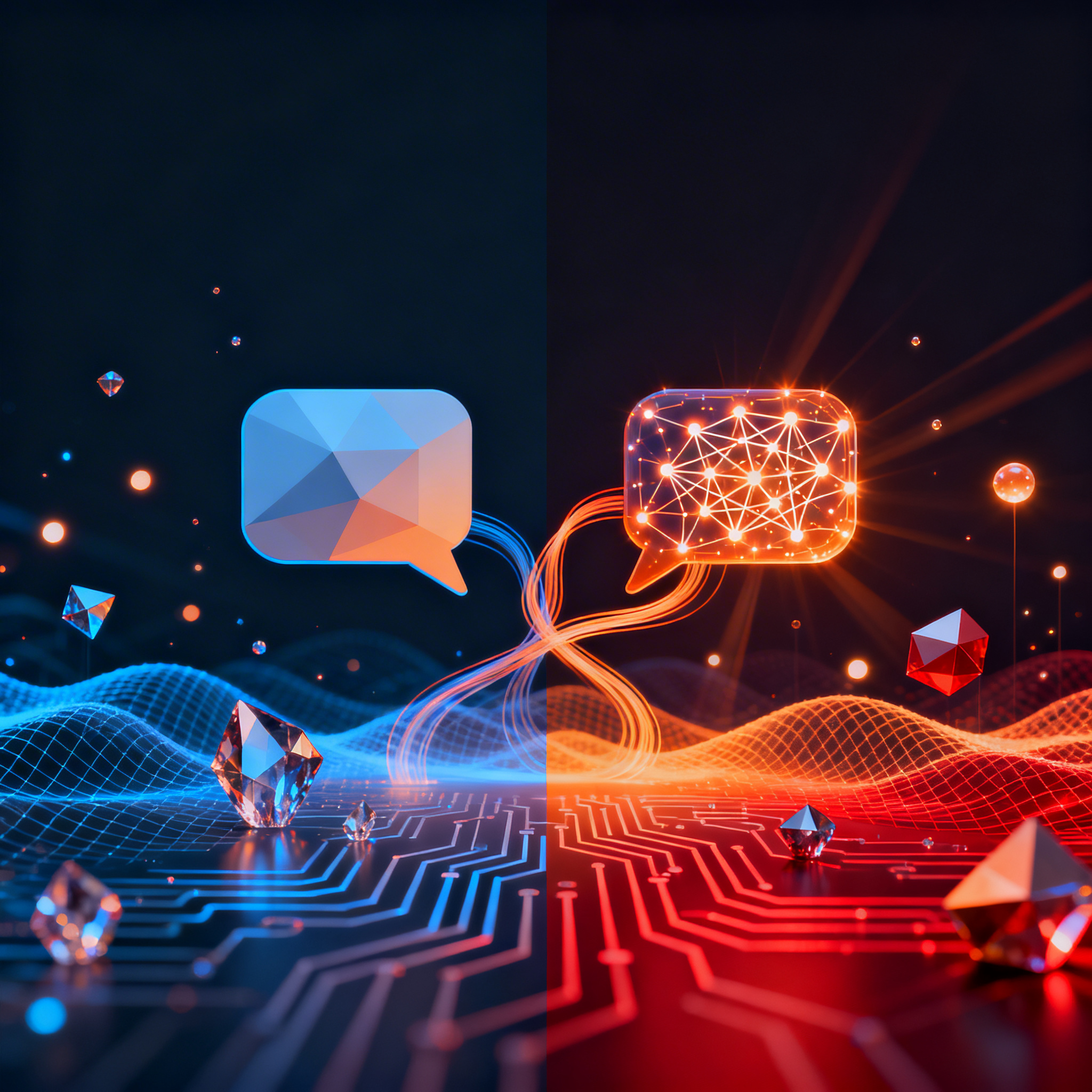
AI Chatbots vs Regular Chatbots: 5 Critical Differences That Impact Your Business in 2025
AI Chatbots vs Regular Chatbots: 5 Critical Differences That Impact Your Business in 2025
If you've ever felt frustrated talking to a chatbot that couldn't understand your question, you've likely encountered a regular chatbot struggling with its limitations. But if you've had a surprisingly helpful conversation where the bot seemed to genuinely understand your needs, you've probably experienced an AI chatbot in action.
The difference between AI chatbots and regular chatbots isn't just technical jargon—it's the difference between customers who leave satisfied and customers who abandon your platform in frustration.
As businesses race to implement conversational interfaces, understanding this distinction has become essential. Let's break down exactly what separates these two technologies and why it matters for your bottom line.
What Are Regular Chatbots?
Regular chatbots, often called rule-based or scripted chatbots, operate on a simple principle: if the user says X, respond with Y.
These systems rely on predetermined decision trees and keyword matching. When a customer types a message, the chatbot scans for specific keywords or phrases and delivers a pre-written response.
Think of them like sophisticated FAQ pages with a conversational interface. They work well for:
- Answering frequently asked questions
- Routing customers to the right department
- Collecting basic information through forms
- Providing business hours or location details
The strength of regular chatbots lies in their predictability. You know exactly what they'll say because you wrote every response. They're reliable, easy to audit, and won't surprise you with unexpected answers.
However, their limitations become apparent quickly. Ask a question slightly outside their programmed parameters, and you'll hit a wall. "I'm sorry, I didn't understand that" becomes a familiar refrain.
What Are AI Chatbots?
AI chatbots represent a fundamental shift in how machines understand and respond to human language. Rather than matching keywords to scripts, they use natural language processing (NLP) and machine learning to interpret meaning and generate contextually appropriate responses.
According to comparative research on modern AI chatbots, these systems can understand intent, recognize context, and even adapt their communication style based on the conversation flow.
AI chatbots can:
- Understand questions they've never seen before
- Maintain context across multiple exchanges
- Learn from interactions to improve over time
- Handle complex, multi-part queries
- Generate unique responses rather than selecting from templates
The technology powering these systems—large language models, retrieval-augmented generation (RAG), and advanced NLP—enables them to engage in genuinely helpful conversations rather than simple pattern matching.
The 5 Critical Differences You Must Know
1. Understanding vs. Pattern Matching
The most fundamental difference lies in comprehension.
Regular chatbots don't understand language—they recognize patterns. When you ask "What time do you close?" they match the keyword "close" to a pre-written response about business hours. Ask "When do you shut down for the day?" and they might fail completely.
AI chatbots actually process language semantically. They understand that "close," "shut down," "wrap up," and "finish for the day" all mean the same thing in context. As detailed comparisons between AI agents and chatbots explain, this semantic understanding transforms the user experience entirely.
This difference impacts customer satisfaction dramatically. Users don't have to guess the "right" way to phrase questions—they can communicate naturally.
2. Static vs. Dynamic Responses
Regular chatbots deliver canned responses. Every customer asking about shipping gets identical text, regardless of their specific situation.
AI chatbots generate dynamic, contextual responses. They can acknowledge the specifics of a customer's situation, reference previous parts of the conversation, and tailor their language to match the user's tone.
Consider this scenario: A customer mentions they're frustrated about a delayed order before asking about a refund policy.
A regular chatbot ignores the emotional context entirely and delivers the standard refund policy text.
An AI chatbot might acknowledge the frustration, empathize with the situation, and then explain the refund policy while offering to expedite a solution.
3. Handling Complexity and Edge Cases
Business conversations rarely follow neat scripts. Customers have unique situations, compound questions, and unexpected needs.
Regular chatbots handle these poorly. When a query falls outside their decision tree, they either provide irrelevant responses or escalate to human agents—defeating the purpose of automation.
Industry analyses of AI agents versus traditional chatbots consistently highlight this limitation. The more complex your customer interactions, the more inadequate rule-based systems become.
AI chatbots excel at complexity. They can:
- Parse multi-part questions and address each component
- Handle unexpected tangents without losing context
- Make reasonable inferences when information is incomplete
- Gracefully acknowledge when they can't help and explain why
4. Learning and Improvement
Regular chatbots are static. They perform exactly as programmed until someone manually updates their scripts. Improving them requires reviewing conversation logs, identifying gaps, writing new responses, and deploying updates.
AI chatbots can improve continuously. Through techniques like reinforcement learning from human feedback (RLHF) and retrieval-augmented generation, they become more capable over time.
More importantly, AI chatbots integrated with your knowledge base can access updated information automatically. When your pricing changes or you launch a new product, an AI chatbot connected to your documentation can immediately provide accurate information without manual reprogramming.
5. Integration and Action Capabilities
This distinction has become increasingly important as businesses expect more from their conversational interfaces.
Regular chatbots primarily provide information. They can tell customers about your return policy, but they can't actually process a return.
Advanced AI chatbots—sometimes called AI agents—can take actions. They can function more like autonomous workers than simple responders, integrating with your systems to:
- Process transactions
- Update account information
- Schedule appointments
- Create support tickets
- Trigger workflows across multiple platforms
The evolution from basic chatbots to capable AI agents represents a shift from conversational interfaces to conversational automation.
When Regular Chatbots Still Make Sense
Despite AI chatbots' advantages, rule-based systems aren't obsolete. They remain appropriate when:
Predictability is paramount. In regulated industries where every customer communication must be pre-approved, scripted chatbots ensure compliance.
Interactions are genuinely simple. If 90% of your customer queries are "What are your hours?" and "Where are you located?", a rule-based bot handles this efficiently.
Resources are extremely limited. Basic chatbot builders require less infrastructure than AI systems, though this gap is narrowing rapidly.
You need complete control. When you absolutely cannot risk an AI generating an inappropriate or inaccurate response, scripts provide certainty.
When AI Chatbots Become Essential
For most modern businesses, AI chatbots have moved from "nice to have" to "necessary." They become essential when:
Customer queries are diverse. If your customers ask questions in countless ways about varied topics, AI comprehension is mandatory.
Context matters. When conversations span multiple exchanges and require memory, AI systems maintain coherent interactions.
Scale demands efficiency. AI chatbots can handle sophisticated interactions that would otherwise require human agents, dramatically improving support economics.
You want competitive differentiation. As critical difference analyses show, customer expectations have shifted. Users increasingly expect intelligent, helpful chatbots—and notice when they get outdated technology instead.
Multi-channel presence is needed. AI chatbots can maintain consistent intelligence across web, mobile, WhatsApp, and embedded widgets.
The Hidden Complexity of Building AI Chatbots
Here's what most businesses discover when they decide to implement AI chatbots: the technology is accessible, but building a production-ready system is surprisingly complex.
You need to consider:
- Knowledge management: How will the AI access accurate information about your business?
- Authentication and security: How do you protect customer data across conversations?
- Payment processing: If the bot handles transactions, how do you manage billing?
- Multi-language support: Can you serve global customers in their preferred language?
- Channel integration: How do you deploy across web, mobile, and messaging platforms?
- Analytics and improvement: How do you measure performance and identify issues?
Each of these represents weeks or months of development work. Most teams significantly underestimate the infrastructure required to move from "cool AI demo" to "reliable business tool."
The Practical Path Forward
For businesses ready to leverage AI chatbots without building everything from scratch, the landscape has evolved significantly.
Modern platforms like ChatRAG have emerged specifically to address this gap. Rather than building authentication, RAG pipelines, payment processing, and multi-channel deployment from zero, teams can start with production-ready infrastructure.
What makes this approach compelling is the combination of sophistication and accessibility. Features like "Add-to-RAG" let you continuously expand your chatbot's knowledge base. Support for 18 languages enables global deployment. Embeddable widgets and WhatsApp integration provide the multi-channel presence modern customers expect.
The difference between AI chatbots and regular chatbots ultimately comes down to capability and customer experience. But the difference between building AI chatbots from scratch and using purpose-built infrastructure comes down to time-to-market and resource efficiency.
Key Takeaways
The distinction between AI chatbots and regular chatbots matters more than ever:
-
Regular chatbots match patterns; AI chatbots understand meaning. This fundamental difference shapes every customer interaction.
-
AI chatbots handle complexity that breaks rule-based systems. Real customer conversations rarely follow scripts.
-
The ability to take action separates basic bots from valuable automation. Integration capabilities transform chatbots from information providers to business tools.
-
Building production-ready AI chatbots requires significant infrastructure. Authentication, payments, RAG, multi-channel—the list extends far beyond the AI itself.
-
Purpose-built platforms dramatically accelerate deployment. Starting with proven infrastructure lets teams focus on customization rather than foundational engineering.
The question isn't whether to upgrade from regular chatbots to AI-powered alternatives. For most businesses, that decision is already made by customer expectations. The question is how quickly and efficiently you can make that transition.
Ready to build your AI chatbot SaaS?
ChatRAG provides the complete Next.js boilerplate to launch your chatbot-agent business in hours, not months.
Get ChatRAGRelated Articles
5 Ways RAG Transforms Customer Service Chatbot Automation in 2025
Customer service teams are drowning in tickets while customers demand instant, accurate responses. Retrieval-Augmented Generation (RAG) is emerging as the breakthrough technology that bridges this gap—combining the knowledge of your entire support library with the conversational intelligence of modern AI.
7 Most Common Chatbot Use Cases Transforming Business in 2025
From 24/7 customer support to intelligent lead qualification, chatbots have evolved far beyond simple FAQ bots. Discover the seven most impactful use cases where businesses are seeing measurable ROI and how you can implement them effectively.
AI Chatbots vs Regular Chatbots: 5 Critical Differences That Impact Your Business in 2025
Understanding the difference between AI chatbots and regular chatbots isn't just technical jargon—it's a strategic business decision. This guide breaks down the five critical distinctions that determine whether your chatbot delights customers or frustrates them.