
What is RAG and How Does It Work? 5 Key Components That Power Modern AI Chatbots
What is RAG and How Does It Work? 5 Key Components That Power Modern AI Chatbots
If you've spent any time exploring AI chatbots for your business, you've likely encountered a frustrating limitation: large language models are brilliant at generating human-like text, but they often hallucinate facts, provide outdated information, or simply can't access your company's proprietary data.
Enter Retrieval-Augmented Generation—or RAG—the architectural pattern that's revolutionizing how businesses deploy AI systems that are both intelligent and accurate.
But what exactly is RAG, and how does it work under the hood? More importantly, why should you care if you're building a chatbot-powered SaaS product?
Let's break it down.
The Problem RAG Was Designed to Solve
Large language models like GPT-4 and Claude are trained on massive datasets, but that training has a cutoff date. They don't know about your product documentation, your customer support tickets, or the policy changes you made last week.
Worse, when these models don't know something, they don't always admit it. Instead, they confidently generate plausible-sounding but factually incorrect responses—a phenomenon known as "hallucination."
For consumer applications, this might be mildly annoying. For business applications where accuracy matters—customer support, legal queries, medical information, financial advice—hallucinations can be catastrophic.
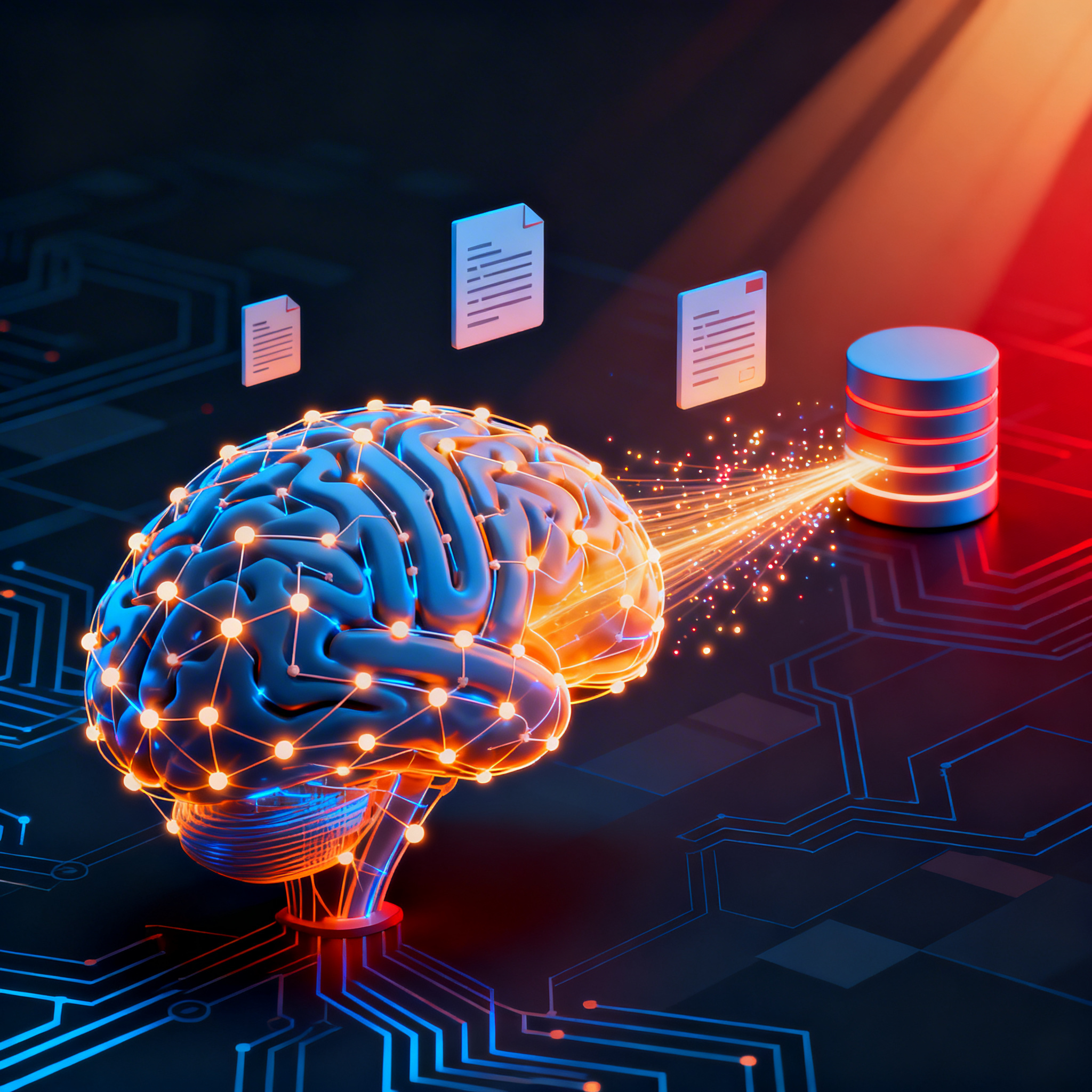
RAG solves this by giving language models access to external knowledge sources at inference time. Instead of relying solely on what the model "memorized" during training, RAG systems retrieve relevant information from your own databases, documents, and knowledge bases, then use that context to generate accurate, grounded responses.
As explored in this comprehensive survey on retrieval-augmented generation for NLP, RAG has become the dominant paradigm for building production AI systems that require factual accuracy and domain-specific knowledge.
How RAG Works: The 5 Core Components
Understanding RAG requires breaking down its architecture into five interconnected components. Each plays a critical role in transforming a generic language model into a domain-specific expert.
1. Document Processing and Chunking
Before your AI can retrieve information, it needs something to retrieve from. The first step in any RAG pipeline is ingesting and processing your source documents.
This involves:
- Extracting text from various formats (PDFs, web pages, databases, APIs)
- Cleaning and normalizing the content
- Chunking documents into smaller, semantically meaningful segments
Chunking strategy matters enormously. Chunks that are too large dilute relevance; chunks that are too small lose context. Modern RAG systems use sophisticated techniques like semantic chunking, which splits documents based on meaning rather than arbitrary character counts.
This engineering deep-dive into document processing and vector search provides excellent technical detail on how production systems handle these challenges.
2. Embedding Generation
Once documents are chunked, each chunk needs to be converted into a numerical representation that captures its semantic meaning. This is where embeddings come in.
Embedding models transform text into high-dimensional vectors—essentially, coordinates in a mathematical space where semantically similar content clusters together. The sentence "How do I reset my password?" ends up near "I forgot my login credentials" because they mean similar things, even though they share few words.
The quality of your embedding model directly impacts retrieval accuracy. Modern systems use specialized embedding models trained specifically for retrieval tasks, not general-purpose language models.
3. Vector Storage and Indexing
With embeddings generated, you need somewhere to store them—and more importantly, a way to search them efficiently.
Vector databases are purpose-built for this task. Unlike traditional databases that excel at exact matches, vector databases specialize in similarity search: finding the vectors closest to a given query vector in that high-dimensional space.
As recent research on how RAG actually works in 2026 points out, modern RAG systems are moving beyond pure vector search to incorporate hybrid approaches that combine semantic similarity with keyword matching, metadata filtering, and knowledge graph traversal.
This hybrid approach addresses a key limitation of pure vector search: sometimes the most relevant document isn't the most semantically similar one. A user asking about "Q3 revenue" needs the Q3 financial report, even if another document about "quarterly performance metrics" might be semantically closer.
4. Query Processing and Retrieval
When a user submits a query, the RAG system springs into action:
- The query is embedded using the same model that processed the documents
- The vector database performs a similarity search
- The top-k most relevant chunks are retrieved
- Additional filtering and re-ranking may be applied
This retrieval step is where the "R" in RAG happens. The goal is to surface the most relevant context for the specific question being asked.
Advanced RAG implementations use techniques like:
- Query expansion: Generating multiple variations of the user's question to improve recall
- Hypothetical document embeddings (HyDE): Generating a hypothetical answer and using that for retrieval
- Multi-step retrieval: Using initial results to inform subsequent, more targeted searches
Research into unified frameworks with self-triggered information planning is pushing the boundaries of how retrieval and generation can work together more dynamically.
5. Context Construction and Generation
Finally, the retrieved chunks are assembled into a prompt that's sent to the language model. This is where the "AG" (Augmented Generation) happens.
The prompt typically includes:
- System instructions defining the AI's role and behavior
- The retrieved context chunks
- The user's original question
- Any conversation history for multi-turn interactions
The language model then generates a response grounded in the provided context. Because it has access to relevant, authoritative information, it can provide accurate answers instead of hallucinating.
One ongoing challenge is context window limitations. Even modern LLMs with 100k+ token windows can struggle when given too much context. Recent work on multi-signal token compression addresses this by intelligently compressing retrieved information while preserving the most salient details.
Why RAG Matters for Business Applications
Understanding the mechanics is useful, but the real question is: why should your business care about RAG?
Accuracy You Can Trust
RAG dramatically reduces hallucinations by grounding responses in verified source material. For customer-facing applications, this isn't just nice to have—it's essential.
When your AI chatbot answers questions about pricing, policies, or product capabilities, those answers need to be correct. RAG makes that possible by ensuring every response can be traced back to authoritative source documents.
Always Up-to-Date
Unlike fine-tuning a model (which bakes knowledge into the weights), RAG systems can be updated simply by adding new documents to the knowledge base. Changed your return policy? Updated your API documentation? Just ingest the new content, and your AI immediately reflects those changes.
This explanation of why retrieval-augmented generation matters highlights how this dynamic updating capability makes RAG particularly valuable for fast-moving businesses.
Cost-Effective Customization
Fine-tuning large language models is expensive, time-consuming, and requires ML expertise. RAG lets you customize AI behavior using your existing content without touching the underlying model.
This means you can deploy domain-specific AI applications at a fraction of the cost—and without needing a team of machine learning engineers.
Transparency and Auditability
Because RAG systems retrieve specific source documents, you can show users where an answer came from. This transparency builds trust and enables compliance in regulated industries.
Imagine a financial services chatbot that not only answers questions about investment products but also cites the specific regulatory disclosures and product documents that support each answer. That's RAG in action.
The Hidden Complexity of Production RAG
Here's what the tutorials don't tell you: building a proof-of-concept RAG system is straightforward. Building a production-ready RAG system that handles real users, real scale, and real edge cases is genuinely hard.
Consider what a production RAG-powered chatbot actually requires:
- Document ingestion pipelines that handle dozens of formats
- Chunking strategies that preserve context across document types
- Embedding infrastructure that scales without breaking the bank
- Vector storage with proper indexing and query optimization
- Retrieval logic that balances precision and recall
- Prompt engineering that maximizes response quality
- Conversation management for multi-turn interactions
- User authentication and access control
- Usage tracking and billing integration
- Multi-channel deployment (web, mobile, WhatsApp, embedded widgets)
- Internationalization for global audiences
And that's before you consider the business logic: subscription management, team workspaces, analytics dashboards, and API access for power users.
Building all of this from scratch takes months of engineering effort. Maintaining it takes even longer.
A Faster Path to Production
This is precisely why platforms like ChatRAG exist. Instead of spending months building RAG infrastructure, you can launch a production-ready AI chatbot SaaS in days.
ChatRAG provides the complete stack pre-built: document processing with support for PDFs and web content, vector storage and retrieval, conversation management, user authentication, subscription billing, and multi-channel deployment including embeddable widgets and WhatsApp integration.
What makes it particularly powerful for global businesses is built-in support for 18 languages and features like Add-to-RAG, which lets users dynamically expand the knowledge base without engineering intervention.
If you're building a chatbot-powered SaaS product, you have a choice: spend your first year building infrastructure, or spend it building the features that differentiate your product.
Key Takeaways
RAG has become the standard architecture for building AI applications that require accuracy, freshness, and domain-specific knowledge. Understanding its five core components—document processing, embedding generation, vector storage, query retrieval, and context construction—gives you the foundation to evaluate and implement RAG-powered solutions.
But knowing how RAG works is just the beginning. The real challenge is operationalizing it at production scale, with all the surrounding infrastructure that enterprise applications demand.
Whether you build from scratch or leverage a platform that handles the complexity for you, RAG is no longer optional for serious AI applications. It's the difference between a chatbot that impresses in demos and one that delivers real value in production.
Ready to build your AI chatbot SaaS?
ChatRAG provides the complete Next.js boilerplate to launch your chatbot-agent business in hours, not months.
Get ChatRAGRelated Articles
What is RAG? 5 Key Components That Make AI Chatbots Actually Useful
Retrieval-Augmented Generation (RAG) is the technology that transforms generic AI chatbots into intelligent assistants that actually know your business. Learn how RAG works and why it's essential for building production-ready AI applications.

5 Ways RAG Transforms Customer Service Chatbot Automation in 2025
Customer service teams are drowning in tickets while customers demand instant, accurate responses. Retrieval-Augmented Generation (RAG) is emerging as the breakthrough technology that bridges this gap—combining the knowledge of your entire support library with the conversational intelligence of modern AI.

5 Ways RAG Transforms Restaurant Menu and Recipe Management in 2025
Restaurant operations are drowning in unstructured culinary data—from handwritten recipes to scattered ingredient lists. RAG (Retrieval-Augmented Generation) is emerging as the game-changing technology that turns this chaos into intelligent, queryable knowledge systems.